For Family Offices · Hedge Funds · Institutional Allocators
A research-grounded derivatives strategy. Closed-loop Greek budgeting.
Gastaldi Quantitative is the institutional implementation of work
published in the academic literature under the Universal Statistical
Edge principle. The strategy manages exposure on regulated derivatives
venues under a closed-loop Greek-budgeting discipline. Investor capital
is never under our custody. The tear sheet and the data room are
available on request to qualifying allocators.
"We do not forecast. We balance exposure. Everything else that is
sold to retail traders — signals, technical analysis, predictions — is,
statistically, noise."
— Prof. Tommaso Gastaldi, principal
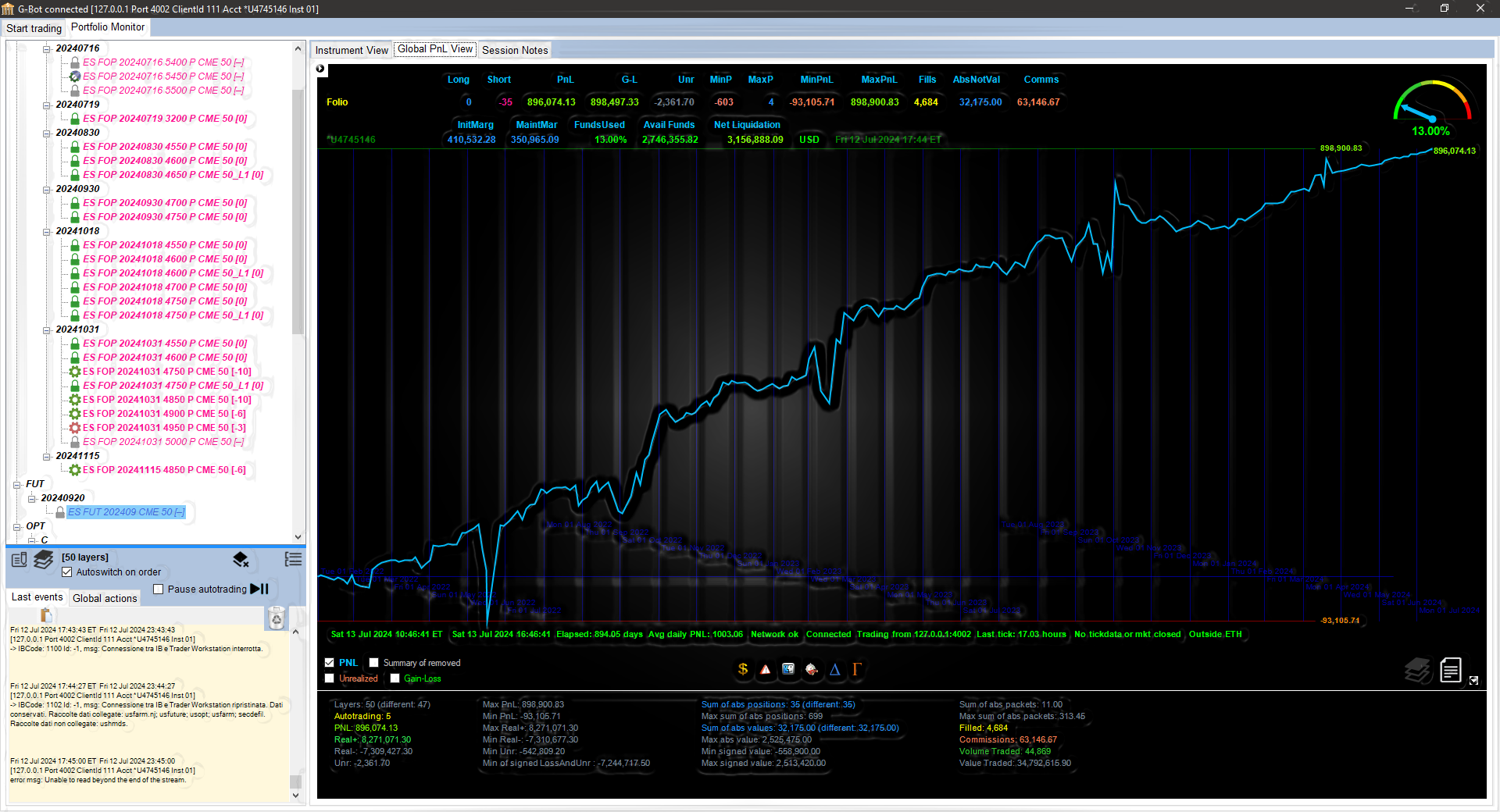
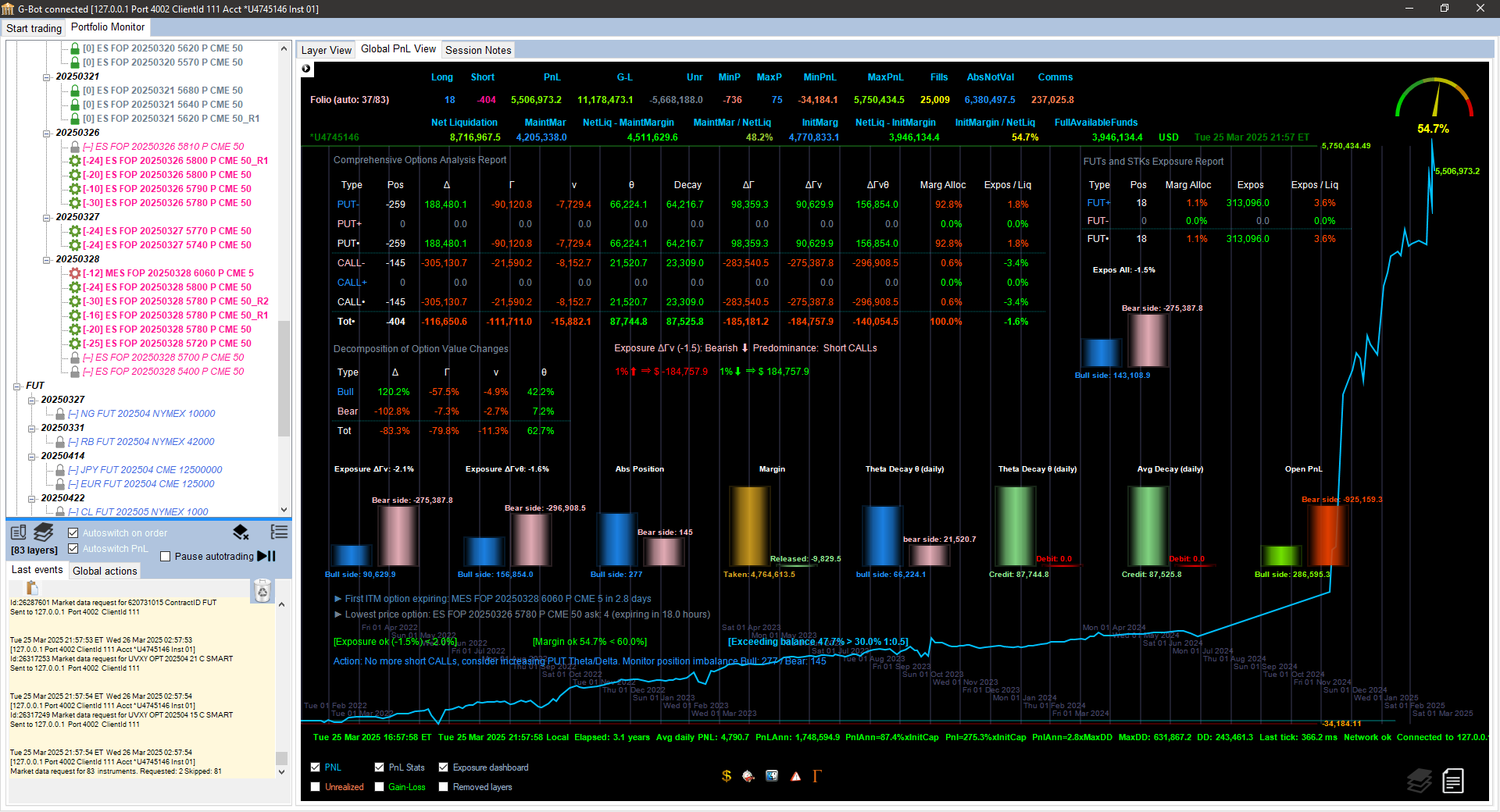
// live operator consoleportfolio · layers · folio monitor
25+
Years of methodology research
arXiv
2404.14252 — peer-visible
$0
Custody of investor capital
$700k
Capital floor · paper evaluation
// 01 · Methodology
The edge is not in the chart. It is in what the book remembers.
The strategy is built on the Universal Statistical Edge
(USE) principle — the result of decades of research on what
compounds in financial markets when forecasting is removed from the
decision loop. Conventional trading lore — signals, technical analysis,
momentum — is explicitly rejected as a primary trigger.
USE Principle
Markets do not have to mean-revert. Inventory does.
The edge does not depend on the underlying reverting. It depends on
inventory cycling through harvest and reset states under an induced
price recurrence created by the bilateral book itself.
Historical Trading Information is the only durable memory.
Every fill, every stranded order, every rollover is preserved as
structured memory. The system does not predict the next tick. It
knows where every existing position came from and the conditions
that would close it profitably.
Bull and bear are coordinates in a balance, not a forecast.
The book manages bilateral inventory whose total exposure is
bounded by hard, non-bypassable Greek caps. Asymmetry is corrected
mechanically. Risk-reducing operations are never gated. New risk
is always gated. "Close-before-open" is sacred.
A one-page institutional brief. The current edition is methodology-led:
strategy, risk architecture, capital requirements. Live performance
statistics — Sharpe, Sortino, max drawdown, Calmar — are released as
the paper evaluation programme accumulates the required observation
window.
Gastaldi Quantitative
Strategy Tear Sheet · Methodology Edition
ForProfessional & Institutional Investors
As of
Strategy
Bilateral derivatives book on regulated venues, managed under the
Universal Statistical Edge (USE) principle. The strategy does not
forecast. It manages controllable inventory recurrence through
rollover, hedge and repair operations, gated by per-Greek hard caps.
Source paper: arXiv:2404.14252.
Risk architecture
Per-Greek hard caps — Δ̄, Γ, V, Θ each have non-bypassable budgets; new risk blocked at cap.
Pre-fill filter set — crossed, stale, wide-spread and thin-book quotes refused before execution.
Margin headroom buffer — bounded against the venue's worst-case stress matrix at startup.
Operator-in-the-loop — per-layer Manual/Auto switch; no autonomous flatten of the entire book.
Performance
Net annualised return
Reporting from Q1 2027
Sharpe (excess)
—
Sortino
—
Max drawdown
—
Calmar
—
Observation window
Paper evaluation in progress
Performance fields are released only after the live paper-trade
programme reaches a statistically significant window. We do not
publish back-test numbers.
We do not try to be clever about the future. We try to be disciplined
about what we already hold. The same set of ideas recurs whether the
book is one instrument or fifty.
01
No signals. No forecasts. No technical analysis.
Every chart pattern, every indicator, every momentum read is
rejected as a primary trigger. Trackers such as the Kaufman SDX
appear only as veto gates, never as buy or sell triggers.
02
Inventory as a controllable price loop.
Each instrument is a Layer. Each Layer contains Players — units
of inventory with a side, an average entry and a lineage. The system
opens, hedges, repairs and rolls Players to harvest the decay and
reset cycle.
03
Rollover is information transfer, not exit.
When a Player rolls, the Historical Trading Information transfers
to the new leg. The price loop does not depend on the underlying
actually mean-reverting — it depends on a controllable recurrence
built from the book's own state.
04
Hard caps are non-bypassable.
Greek budgets, exposure caps and margin fractions block new risk
unconditionally. Closes, forced flatten and risk-reducing hedges are
always allowed. "Close-before-open" is the operating axiom.
05
Filters before fills.
Crossed quotes, stale quotes, out-of-line bid or ask, thin
top-of-book sizes — all of them are refused. The filter set is the
single most rewritten part of the codebase. The defaults are
paranoid by design.
06
Operator-in-the-loop is mandatory.
Every Layer has a Manual / Auto switch. Every order is visible in
the order book before fill. There is no "flatten the whole folio"
button by design — if you need to flatten, you flatten Layer by
Layer while watching each fill.
07
Capital is part of the strategy.
The system is engineered to scale — single accounts up to
roughly USD 500 million, multi-account architectures beyond. Under
the capital floor, the system will not generate meaningful work.
This is the only honest answer.
08
Volatility is opportunity, not threat.
The largest absolute profits arise from movement, not calm. Quiet
markets produce few opens by design. Active markets produce the most
information — if filters and caps are respected.
// 04 · Architecture
How a mandate actually runs.
The strategy runs on the investor's own infrastructure or on a
dedicated trading workstation under our operation. It talks to the
prime broker over a single user-defined encrypted port. Investor
capital never moves under our control.
No custody. No co-mingling.
The execution engine communicates directly with the venue's
gateway over an encrypted link. Tick data, Greeks, fills, rejections
and margin events flow on that link and nowhere else. Capital
remains in the investor's own prime brokerage account at all times.
This is an architectural choice, not a compliance frill:
what is not collected cannot be betrayed. What is not stored
cannot be disclosed.
Pseudonymity is permitted during evaluation.
During the paper evaluation phase, allocators may engage under a
pseudonym. Identity disclosure is required only at the live
mandate stage.
// architecture · prime gateway · HTI loop
Stage 1 · Paper evaluation
Live tick data. Fictitious funds. Zero risk to the allocator.
You evaluate the strategy on a Portfolio Margin paper-trading
account using live exchange data. Every fill, every Greek, every
cap event is observable. There is no obligation to move to a live
mandate and no time limit on this stage.
Stage 2 · Live mandate
Same software. Same console. Investor's capital. Investor's prime.
Once you have verified forward behaviour with your own eyes, the
execution engine is repointed at a live account. Nothing is
installed on our side. Capital stays in your prime brokerage account.
Custody never transfers.
Stage 3 · Scale
Multi-account architecture from a single operator console.
Single instances cap at approximately USD 500 million for clean
risk segmentation. Beyond that, multiple instances run against
separate sub-accounts from one console — designed for family
offices and multi-mandate allocators.
Capital floor · honest answer
Minimum USD 700,000. Optimal from USD 3 million.
The instruments the strategy trades require adequate capital to
keep Greek budgets, exposure caps and margin headroom in healthy
territory. Under the floor, the system simply will not generate
meaningful work. This is the answer, not a marketing position.
// 05 · Transparency
Don't take our word for it. Watch it run.
We do not publish back-tests — back-tests are tuneable. We publish
live operator sessions, and we hand qualifying allocators the
executable so the strategy can be observed on their own console.
Forward performance, on your screen, is the only number that matters.
Recorded sessions
Forward sessions on YouTube
Annotated operator sessions, including drawdown moments, fills,
repairs and rollovers. Loss windows are not edited out.
Principal of Gastaldi Quantitative and author of the Universal
Statistical Edge principle. A long-standing presence in the
academic literature on quantitative finance, Prof. Gastaldi has
been a guest commentator on Italian prime-time television
(Anno Zero, Michele Santoro) and publishes both the
academic and the operator-facing material of this initiative under
his own name.
arXiv 2404.14252 · ResearchGate · Business Reporter · datatime.eu
// 07 · For allocators
Three doors. One data room behind them.
The qualifying conversation differs by allocator type. The data room
is the same; what we ask of you, and what you ask of us, is not.
The data room contains the methodology brief, risk-architecture
documentation, recorded operator sessions, and the paper-evaluation
packet. It is shared on a per-allocator basis. We respond directly,
by email, within two business days.
By submitting, you confirm that you are acting in a professional
capacity for an institutional, family-office, or qualifying
professional-investor mandate. We do not engage retail enquiries
via this channel.
The long-form archive. The pieces below are where the operator voice
comes through most directly — the best way to decide whether the
methodology fits how your committee thinks about derivatives mandates.
From private initiative to publicly traded company.
This is not an offer or a solicitation. It is a statement of intent.
The long-term path of Gastaldi Quantitative is a transition into a
publicly traded company in partnership with a major financial
institution with substantive expertise in the IPO process. Early
participants in the private stage have a documented path into that
transition.
We are in active conversation with prospective Strategic Sponsors
— allocators with the expertise and relationships to lead a
transition of this kind. If you recognise yourself in that
description, we invite a direct conversation.